
By LaRayne Topp
Welcoming candlelight flickering at the windows, forest-green crowns fashioned of evergreen twigs, and Maypoles festooned with ribbons. Fragrant saffron buns, delicately smoked salmon and spicy pickled tongue. Young Viking Princes, Little Miss Swedens and Star Boys. Add in a few delightfully ugly trolls captured from Swedish folklore and you’ll have the hallmarks of a Swedish festival, such as the ones you’ll discover at Oakland, Nebraska. After all, Oakland is the Swedish Capital of Nebraska, named so in 1987 by then-Governor Kay Orr.
There’s no argument about that title except, maybe, at Stromsburg, Nebraska, known as the Swede Capital of the state.
Located along the tracks of the Burlington Northern Santa Fe Railroad, Oakland stands at the apex of two Nebraska highways—north and southbound 77 and East-West 32. The community’s population of around 1,300 is made up of a plethora of Swedes with a few from other cultural backgrounds mixed in for good measure.
Take Marilee Groth, for example. Although she claims Swedish ancestry, her husband is of German descent. “But we don’t do DNA tests,” she explained, claiming him as well.
Visitors are welcomed to Oakland with signs of “Vallkommen,” coupled with brightly colored yellow and blue Swedish Dala horses. Dalas stand in eager anticipation on street signs and sides of businesses.
These Swedish touches initially drew Sara-Maria Stites to town, so much so that she has opened one of the Oakland’s latest new businesses, Dillstrom’s Fika Kafe. Named after her mother, Ingrid Dillstrom, who was born in Sweden, the words Fika Kafe translate into the Swedish custom of enjoying coffee and a treat. Customers stop by to enjoy Swedish and Danish pastries there, such as Swedish kollarbar, heart-shaped with a strong almond taste, or flavorful cardamon buns.
These Scandinavian delicacies are baked by Julie Johnson and sold at her family’s grocery, Nelson’s Food Pride, alongside Swedish meatballs, potato sausage and rye bread; ostkaka, a type of cheesecake; and lefse which is a soft, thin, unleavened bread.
In addition to delicious foods and other signs of welcome, Stites also enjoys the Swedish architecture featured in a number of Oakland homes. Focusing on clean lines, natural materials and simplicity, the homes are typically painted in muted shades of grey, forest green, burnt orange, dusty pink or pastel blue.
With all of these Swedish touches, it would appear that the town’s name, itself, would have a Swedish derivative. However, John and Inger Oak were among a band of 23 pioneers from a Norwegian settlement in Iowa, who in 1855 became the founders of Oakland. The Swedish town was named after John Oak, a Norwegian; it’s enough to make a Swedish troll scowl.
Today, Oakland has deep roots in Sweden through a sister city: the small village of Hammenhög in the province of Skane. In past years, high school students from each country have exchanged visits, with Nebraska students finding surnames matching those in Oakland, descendants of Norsemen who once sailed on Viking ships: Andersons and Johnsons, Olsons and Swensons.
In the summer, the adventures of these Norsemen are celebrated as people visit the town’s Swedish Troll Stroll area or the outdoor Swedish Midsommar festival. Traditionally held on a Friday in June, the celebration welcomes in the longest day of the year with flowers and feasting. Ribbons are tied to the top of a tall and gaily decorated Maypole while people grab the end of a ribbon and dance around the pole, singing songs focused on nature and magic, many wearing newly-fashioned flower crowns. The longest day ends with a traditional Swedish smorgasbord, a mix of cold and hot foods set out on a lengthy table.
Whereas Midsommar festival observes the longest day of the year, Lucia Night on December 13, celebrates the longest night of the year. Saint Lucia or Festival of Lights replaces nights of darkness and cold in a triumph of light and warmth.
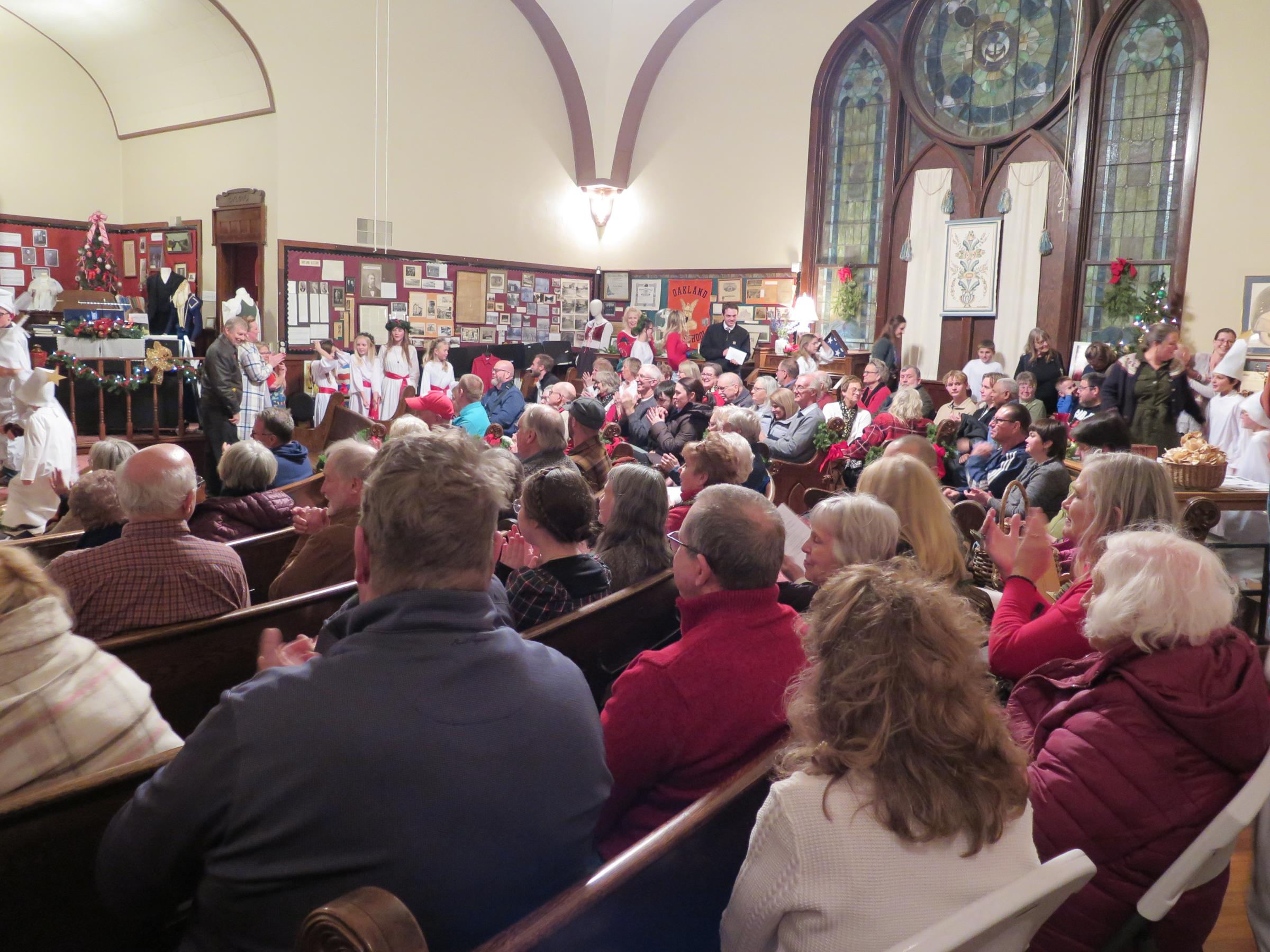
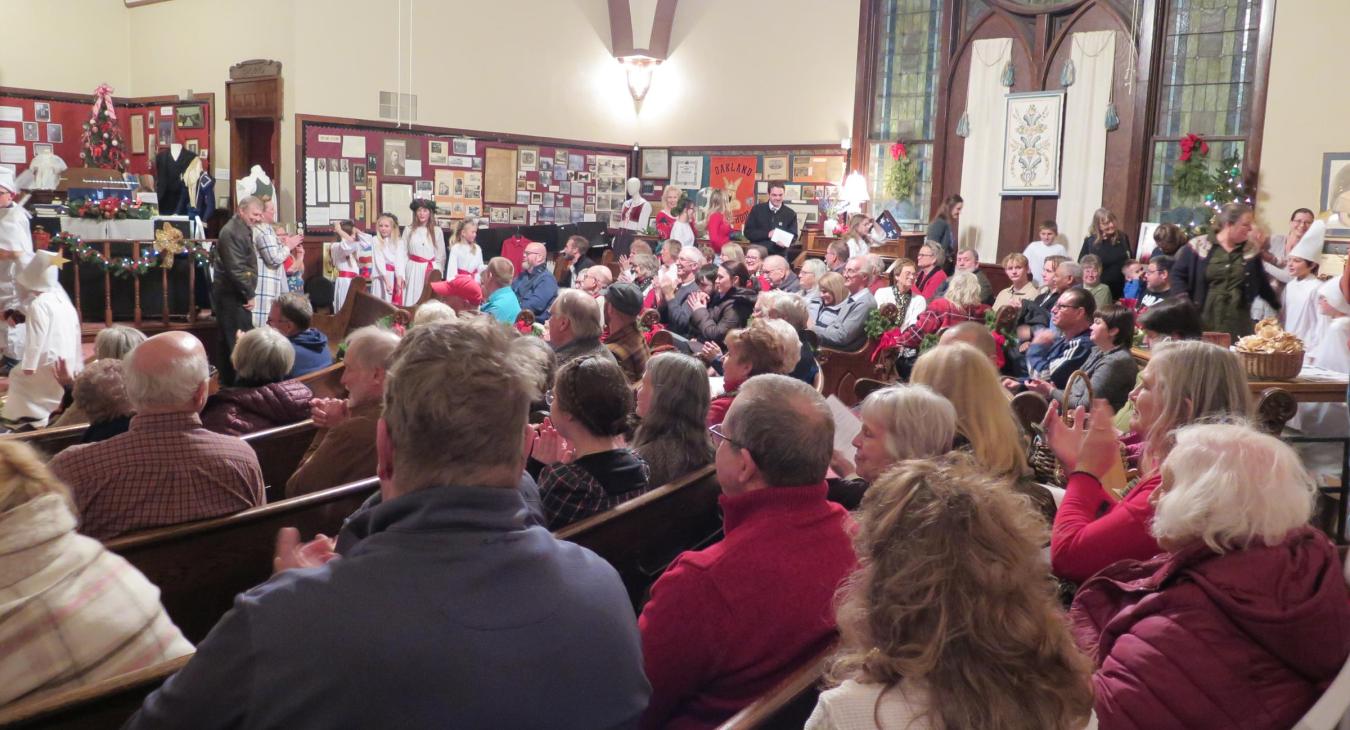
The crowning of Saint Lucia, honoring the Italian martyr St. Lucy, takes place each year at Oakland’s Swedish Heritage Center, housed in the former First Covenant Church. Early settlers’ faith was important, so it’s no surprise that a number of churches—Lutherans, Baptists, Covenants, Methodists and Free Mission congregations—sprung up in the community.
Historical displays are situated among the Center’s spacious aisles and wooden pews, smoothed by years of congregant members sliding into their favorite spots. Wedding gowns and military uniforms, traditional Swedish clothing and family memorabilia, plus replicas of early-day kitchens, dining and living rooms, are tucked away in what used to be the gathering place for Sunday School classes, choir practice and Ladies Aid meetings. Flags of each Swedish province line a wall.
Julie Nelson and her sister Marilee Groth were lifetime members before the congregation closed in 1985, recalling the days when services were spoken entirely in Swedish.
Now, Nelson says, the building with all of its Swedish memorabilia is the most beautiful it has been in her lifetime. Sara-Maria Stites describes the candlelit church, especially during Saint Lucia, as magical.
Parents, grandparents, Swedes and wanna-be Swedes pack the pews in this magical space as young girls process down the center aisle, arrayed in full-length, white gowns, tied at the waist with a bright red ribbon. Each carries a candle. Chosen by her involvement in Swedish activities, one of the girls has the honor of leading the handmaidens, carrying a red tray of sweet saffron buns, called Lussekatter, shaped like curled-up cats with raisin eyes.
Star boys, also dressed in white robes and wearing tall, paper cones on their heads, carry stars on sticks. Once assembled, traditional Swedish songs are sung. Many Swedes know this English translation by heart:
The night treads heavily around yards and dwellings.
In places unreached by sun, the shadows brood.
Into our dark house she comes, bearing lighted candles—
Saint Lucia, Saint Lucia.
At the end of the program the boys and girls choose folks from the audience, grab hands, sing and dance around the Christmas tree, or in this case, around the pews.
One of the visitors to this year’s Saint Lucia festival was Julie Frerichs of Pilger, Nebraska. She grew up as Julie Holstrom in Northeast Wisconsin in a Swedish Lutheran community and often played the role of Saint Lucia as a child. Visiting Oakland, especially during the Saint Lucia observation, gave her a chance to recall a number of songs from her childhood as well as the tradition of dancing around the Christmas tree.
Although it was the Frerichs family’s first visit to Oakland, Ted and Susie Rudberg take part in the Swedish Festival of Light every year, driving from their home an hour away. This year their granddaughter, Inga Speiser, was chosen for the role of Saint Lucia. One hundred percent Swedish, the Rudbergs describe the festival as “always wonderful.”
“It’s everything positive you can say about it,” Susie explained, “for a small town to put something like this on.”
In addition to Saint Lucia, each month, the Heritage Center volunteers host meals and cultural celebrations. At Eastertime, for example, people gather to observe Glad Pask which means Happy Easter in Swedish. Children go door-to-door for treats while watching out for Easter witches. In May, it’s the Mexican-American Cinco de Mayo dinner; in October it’s German Oktoberfest; and in November, it’s a United States Thanksgiving, with turkey and all the trimmings.
In a town such as Oakland, with Swedish smorgasbords often as the focal point, monthly celebratory trimmings might include smoked salmon, head cheese, pickled beef heart and even Smorgastarta. Swedish for sandwich cake, Smorgastarta is an elaborate, frosted cake composed of layers of bread, meats and creamy sandwich fillings.
These delectable dishes are among the Swedish traditions to be enjoyed in the Swedish Capital: Oakland, Nebraska.
To learn more, take a peek at the Heritage Center’s web page: Swedishheritagecenter.org.